Bagua — The Eight Sectors (Eight Realities)
Eight orientations of the Tai Chi node — the 8 vertices of Q₃. UPDATED honest scope: these are REAL as the 8 internal-gauge SECTORS (the particle charge/flavour types) coexisting in ONE reality and verified by SymPy; the older reading of them as 'eight parallel 3D worlds we live one of' is a SPECULATIVE interpretation, NOT part of the rigorous theory.
spt_danode_8realities.py). (B) Eight PARALLEL 3D WORLDS we each 'live one of' — this is a SPECULATIVE interpretation with no evidence; the FTL / cosmic-frontier study found no way to verify or reach a parallel world, and it is NOT part of the rigorous theory. The narrative below uses picture (B) as an evocative, cultural reading — but the VERIFIED content is (A). See The Eight Bagua Trigrams, DAbit & DANode for the rigorous version.When a Tai Chi node spins around its inner axis, the orientation of its membrane can lock into a small number of stable phases. Mathematically there are infinitely many possible angles around the axis; physically, only eight of them are phase-coherent and stable. Those eight stable angles are the Eight Trigrams of the I Ching — Càn ☰, Khôn ☷, Chấn ☳, Tốn ☴, Khảm ☵, Ly ☲, Cấn ☶, Đoài ☱. Each trigram is a stable angular configuration of yin and yang — in the rigorous theory a distinct internal-gauge sector (a particle charge/flavour type); in the interpretive picture below, a 3D 'slice'.
Why exactly eight?
The number eight is not arbitrary; it falls out of the One Tai Chi's subdivision history. Three subdivision steps () saturate the angular freedom around the time-string's axis. After three steps, every angle is occupied by a stable configuration; further subdivision adds nodes within each existing slice rather than creating new slices. Geometrically: the cube has eight corners, the compass has eight directions — eight is the largest number of angles around an axis that the human eye and most physical detectors can resolve as distinct stable orientations. Beyond that, neighbours blur into a continuum.
This is why the I Ching named exactly eight — because eight is the number the geometry actually contains. Phục Hy three thousand years ago saw what modern physics is only now formalising.
The Earlier-Heaven (Tiên Thiên) arrangement
The eight trigrams arrange around the central Tai Chi in perfectly opposed pairs. Càn (☰ pure Yang) sits at the top directly across from Khôn (☷ pure Yin) at the bottom. Every other trigram is paired with its polar opposite across the centre. This is the Earlier-Heaven arrangement attributed to Phục Hy — the resting, structural form that captures the static geometry of the time-string seen along its axis.
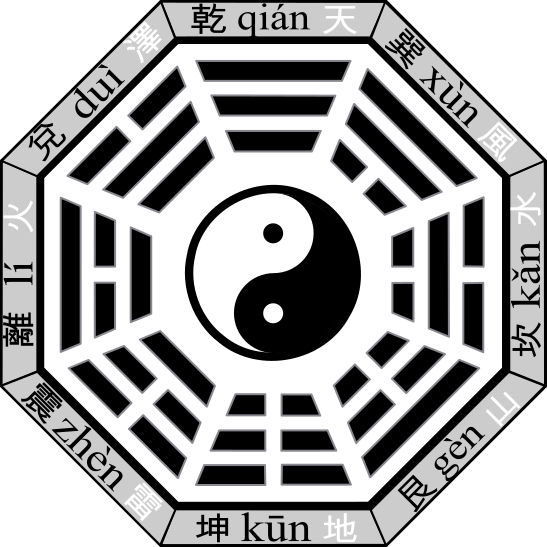
The eight realities, one by one
1. Càn ☰ — Heaven · our reality
Three unbroken Yang lines · pure Yang. Càn is the slice of pure light — the material reality we inhabit. Maximum yang phase, where nodes spin coherently and the membrane swap is dominated by white. This is our 3D world. Light, matter, atoms, life, every visible structure we know — all of it is the Càn projection of the time-string. Our biology has evolved to detect Càn-phase signals; our instruments are tuned to it. Càn is the slice we call "reality" because it is the only one we can read directly.
2. Khôn ☷ — Earth · pure darkness
Three broken Yin lines · pure Yin. The exact polar opposite of Càn — the slice of pure darkness, the realm where the dark face of the membrane dominates. The unseen worlds, the home of the formless. We cannot see Khôn directly because our detectors are tuned only to Yang signals. But we can feel Khôn through its gravitational pull (= dark matter), its background pressure (= dark energy), and as the substrate of the unconscious. Khôn is not an absence; it is a different reality, every bit as full as Càn — just rotated 180° in phase.
3. Chấn ☳ — Thunder · sudden phase collapse
Yang at the bottom, Yin above. Chấn is the thunder slice — the slice of sudden phase collapses. The membrane snaps from one configuration to another in a high-amplitude flash, and that snap ripples across the other slices through the shared membrane. This is the geometric origin of quantum measurement: every "collapse" we observe in Càn is a Chấn-class event reaching us from the membrane. Phenomena: lightning, gamma-ray bursts, sonic booms, abrupt phase transitions, the moment a quantum state becomes definite. Classical name: thunder.
4. Tốn ☴ — Wind · soft, dispersed propagation
Yin at the bottom, Yang above. Tốn is the wind slice — soft, dispersed phase patterns, the gentle propagation of waves through low-density regions. Where Chấn is the abrupt strike, Tốn is the long, even draft. The membrane slopes smoothly from one phase to another over distance, with no sharp boundary. Phenomena: long-range fields, wave drift, atmospheric circulation, the steady spread of influence in a thin medium. Classical name: wind — that which penetrates without breaking.
5. Khảm ☵ — Water · gravitational pooling
Yin top and bottom, Yang in the middle. Khảm is the water slice — dense rotating clusters of in-phase nodes. Gravitational attraction emerges from this slice: when many nodes share the same phase and pool together, their joint membrane curvature is felt by neighbouring nodes as an attractive pull. A Yang heart wrapped inside a Yin envelope — the bright core is the in-phase pool, the dark envelope is the surrounding phase fall-off. Phenomena: galaxy halos, gravitational lensing, fluid dynamics with internal structure, the feeling of depth and density that water carries. Classical name: water.
6. Ly ☲ — Fire · radiant high-frequency flipping
Yang top and bottom, Yin in the middle. Ly is the radiant slice — high-frequency flipping creates radiant photons, the realm of stars and fire. The polar opposite of Khảm: a Yin heart wrapped inside a Yang envelope, the membrane radiating outward with a hidden absorptive core. Phenomena: plasma, sustained radiation, stellar interiors, sustained luminescence, the felt-sense of brightness with hidden depth. Classical name: fire.
7. Cấn ☶ — Mountain · phase-locked stillness
Two Yin below, one Yang on top. Cấn is the mountain slice — locked phases so densely in-phase that matter appears stationary across many time-cuts. The membrane refuses to flip, holding its current state with extreme persistence. This is the geometric origin of solid matter, of "things that just sit there". Phenomena: phase-pinning in condensed matter, crystalline lattices, geological stability, meditative silence, the tipping point that does not tip. Classical name: mountain — that which holds.
8. Đoài ☱ — Lake · entanglement mirror
Two Yang below, one Yin on top. Đoài is the reflective slice — nodes here mirror neighbouring slices, and entangled membranes carry information across realities. The polar opposite of Cấn: an open Yin surface that exchanges freely with the surrounding slices. This is where quantum entanglement "lives" geometrically: an entangled pair shares a Đoài-class membrane patch, so a measurement on one is instantly reflected on the other through the mirror. Phenomena: EPR pairs, open quantum systems, Bell-correlated states, communicative resonance, joy and laughter as social phase-coupling. Classical name: lake — that which receives without losing itself.
All eight at a glance
The four polar pairs
Notice the structure: every trigram has a unique "opposite" — the trigram you get by flipping every yin to yang and vice versa. There are exactly four such opposed pairs, and they sit on perpendicular axes of the central Tai Chi:
What fills each reality
Each of the eight slices is a complete 3D world — not a partial dimension, not a layer, not a sub-region. Each has its own arrangement of nodes, its own apparent matter, its own apparent forces, its own observers from inside. From inside Khôn, an observer would see Khôn as the bright "reality" and Càn as the dark/unseen realm — symmetric to how we see Càn as bright and Khôn as dark. From inside Chấn, the laws of physics would emphasise sudden transitions; the natural rhythm of life there would feel different.
What can cross between realities
The eight slices share one membrane — the same outer skin of the time-string. That is what makes phenomena like entanglement, dark matter and intuition possible.
- Gravity reaches across slices. A massive cluster of in-phase nodes in Khôn pulls on a node in Càn through the shared membrane. We measure this pull as dark matter, never seeing the source.
- Entanglement crosses slices. Two nodes that share a membrane patch can have their patches threading through different slices simultaneously. Measuring one anchors the patch; the other updates instantly because there is only one patch.
- Dreams, intuition, synchronicities are felt traces of patterns whose centre of mass sits in a non-Càn slice but whose membrane patches still touch ours. We do not see the source; we feel the resonance.
- Light, EM and ordinary causality stay within Càn. The visible-light photons your eye reads are pure-Càn flips. They cannot, in normal conditions, propagate across slice boundaries — which is why our world looks self-contained even though it is just one slice of a larger geometry.
How this differs from Many-Worlds
The Many-Worlds Interpretation of quantum mechanics says reality keeps branching into infinite copies on every measurement. Bagua's eight realities are different: finite (just eight), structural (always there from the start, never created on the fly), and connectable (gravity and entanglement reach across them). Many-Worlds is a quantum-measurement bookkeeping device; the eight Bagua slices are a geometric fact about the time-string. See vs. Many-Worlds Interpretation for the detailed comparison.
Implications
- Reality is not flat. Saying "the universe" really means "the Càn slice of the time-string". The full universe has eight slices.
- Most of the mass-energy in the universe lives outside Càn. Dark matter (~27%) + dark energy (~68%) sums to ~95%. Càn-visible matter is only ~5%. The other 95% is the gravitational signature of the seven non-Càn slices.
- Consciousness may not be confined to one slice. A coherent multi-node pattern (a self) can have its centre of mass slowly drift between slices — that drift is, in spiritual traditions, called dreaming, meditation, dying, being reborn. See Souls in Other Slices.
- The I Ching's claim becomes literal. When the Hệ Từ Truyện says "Bát Quái sinh vạn vật" — "the eight trigrams give birth to all things" — it is no longer poetry. It is the literal physical statement that everything we observe is built from nodes whose membrane patches touch one or more of these eight stable phase configurations.
Comments — Bagua — The Eight Sectors (Eight Realities)