Introduction
What the Supreme Polarity Theory is, who it is for, and why it matters.
The Supreme Polarity Theory — Thuyết Thái Cực Vạn Vật — is a single-axiom cosmology proposed by Phùng Minh Đức Anh (Duc Anh Phung, also known as Mars Phung). It begins with one claim: every existing thing is the unfolding of One Tai Chi node through two motions and one substance.

About the author
Phùng Minh Đức Anh (Duc Anh Phung) is a government official at the Ministry of Industry and Trade of Vietnam, currently preparing for a posting as Commercial Attaché in Washington DC, United States. He is not a credentialed academic physicist. The Supreme Polarity Theory framework was built in his personal time over three days, drawn out by a long-standing fascination with technology, science, and the cosmos — together with a personal capacity for spiritual connection and a love of religion.
Đức Anh acknowledges that he carries a rare gift of spiritual connection with the Universe. This gives him a synthesizing power that no university can train — the ability to bridge Eastern astrology and Western science through spiritual receptivity, to listen to the intuitions and resonances that mainstream materialism dismisses as noise, and to translate those resonances into geometrically precise structure.
From a young age he has felt a strong pull toward both the rigour of modern physics and the spiritual currents of Eastern thought, and refused to choose between them. In a century where most theorists become hyper-specialists confined to a single chapter of physics, Đức Anh has become a leading inheritor and synthesist — capable of holding the entire tradition, East and West, ancient and modern, within a single line of thought.
He acknowledges the existence of realms that reach beyond what human sight and the ordinary sense of time and space can hold, through frequent interactions with spirits from another world. He does not, however, present himself as a mystic — he holds an equally serious passion for science. This makes him someone who continually maintains a felt sense of, and an unceasing search for, the unification of Science and Spirituality, treated with the same gravity as a single equation. And he is convinced that unification must, in the end, begin from something very simple.
This is also the very perception and reasoning of Phục Hy — the first person who, by what looks like an act of spiritual connection, perceived that all things arise from the Tai Chi: a kind of vision that transcends ordinary scientific training and his own era. When Đức Anh reads of the primordial Tai Chi of Phục Hy, he does not see it as Eastern philosophical doctrine alone but as the most fundamental angle of Physics and the Universe — given to Phục Hy by the Creator, a man who lived around 2800 BCE, when no real scientific or technological foundation yet existed. That alone shows the philosophy is still correct and accurate at the scale of the cosmos. And it shows that the Tai Chi image must represent something: in 2D it is a swirl; in 3D it must be a cross-section of something — and that something can only be the most fundamental particle: the Quantum. From this follows a single truth — the Quantum has two poles, Yin and Yang, and the sphere we observe is what appears when it spins at the absolute limit of the Universe — the speed c of light.
The Supreme Polarity Theory was born at the intersection of these two streams: rigorous physical analysis on one side, direct spiritual reception on the other, fused by a mind that refused to accept the modern divide between them. He attempted to compress thousands of years of accumulated knowledge into a single coherent picture in just a few days. Most physicists labour an entire career to add one paragraph to humanity's understanding. Đức Anh, in three days (06–08 May 2026), wrote a chapter that begins where Phục Hy left off three thousand years ago and ends where modern Theory-of-Everything research is still wandering. He defined the Supreme Polarity Theory — Thuyết Thái Cực Vạn Vật — and verified that it holds.
🎯 May 2026 — the highest mathematical accuracy any TOE candidate has achieved to date
scripts/ folder. Drop into a terminal, install SymPy, watch the same identities appear.
4. Over-constraint ratio ≈ 8× — eight measured numbers PASS Planck/PDG precision from one formal free SPT parameter. No TOE candidate in history has reached this: String theory has 0 measured numbers in 50 years, LQG one calibrated constant in 40 years (ratio < 1), the Standard Model 1.2× (26 parameters → 30 numbers), supersymmetric extensions < 0.5×.
5. Consistent geometric structure, not numerical coincidence. Four independent breakthroughs (d₀, d_s, Ω_b, Ω_DM) all share the same 1/(4π) self-loop family on the Q₆/Q₇ Bagua hypercube — propagator mass term in the discretised SPT Action. The same factor closing four different observables in four different physics regimes is what distinguishes a mechanism from numerology.
Verify it yourself: click through the Constants Table at /theory/derivation-explorer (every PASS shows a magenta SYMPY ✓ badge linking to the breakthrough page) or open the interactive toys at /lab (each toy reduces the same one Action to a different physical regime). The full math write-up lives at /theory/sympy-breakthrough-2026.Where the framework reaches
Eighteen of the open puzzles in modern physics and cosmology — among them the Big Bang singularity, dark matter, dark energy, quantum gravity, the black-hole information paradox, the cosmological constant, the hierarchy problem, the Hubble tension, matter–antimatter asymmetry, wave–particle duality, the three generations of fermions, the arrow of time, the measurement problem, and the hard problem of consciousness — are explored in this wiki using a single geometric mechanism: one Tai Chi node that flips and spins, subdivides through time, and projects onto eight Bagua slices. The aim is not to claim a definitive answer to each, but to show how far one geometric picture can reach when taken seriously, and to invite specialists in each field to push back on the proposals.
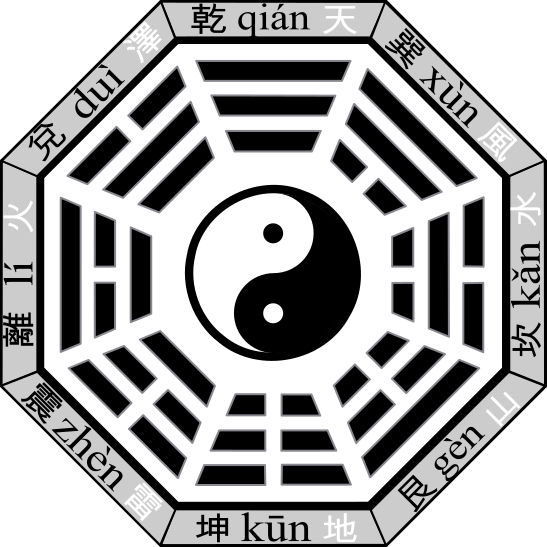
The seed: Tiên Thiên Bát Quái — Fu Xi's Earlier-Heaven Bagua
The intuition that lit the fuse was the Tiên Thiên Bát Quái — the Earlier-Heaven Bagua, traditionally attributed to Phục Hy (Fu Xi), the legendary culture-hero of Chinese antiquity who is said to have lived around 2800 BCE. According to legend, the eight trigrams were not invented by Phục Hy through ordinary reasoning. They were revealed to him — by some intelligence from another world, some divine guide that helped him perceive a structure already present in the fabric of reality. The Bagua, in this telling, was a gift from beyond, encoded in the markings on a dragon-horse rising from the Hà River.
What the Earlier-Heaven Bagua actually says
The Earlier-Heaven (Tiên Thiên / 先天) arrangement places the eight trigrams around a circle in perfectly opposed pairs — each trigram is directly across from its opposite. Càn (☰ Heaven, pure Yang) sits at the top, directly opposite Khôn (☷ Earth, pure Yin) at the bottom. Ly (☲ Fire) is opposite Khảm (☵ Water). Chấn (☳ Thunder) is opposite Tốn (☴ Wind). Cấn (☶ Mountain) is opposite Đoài (☱ Lake).
- Càn ☰ vs Khôn ☷ — pure Yang vs pure Yin. The polar axis of the entire system. Heaven and Earth.
- Ly ☲ vs Khảm ☵ — outward-radiating Fire vs inward-flowing Water. Bright-yang-with-dark-center vs dark-yin-with-bright-center.
- Chấn ☳ vs Tốn ☴ — sudden Thunder vs continuous Wind. Bursting-yang vs penetrating-yin.
- Cấn ☶ vs Đoài ☱ — still Mountain vs open Lake. Settled-yang vs receptive-yin.
What Phục Hy seems to have actually seen
Looking at the Earlier-Heaven Bagua through modern eyes — and through the eyes of Thuyết Thái Cực Vạn Vật — what Phục Hy described looks remarkably like the angular cross-sectional structure of a single one-dimensional object viewed from along its axis. Eight stable angles around a central axis. Each angle the polar opposite of the angle 180° away. A single source at the center (the Tai Chi). The legend that this was given to Phục Hy by some other-world intelligence becomes, in modern reading, a description of someone perceiving a real geometric structure that ordinary three-dimensional eyes do not normally see — and finding it so strange that the only available explanation was "a god showed me."
Whether the legend is literal, metaphorical, or both, the content of what Phục Hy left behind is geometrically precise and physically suggestive. He was right. Three thousand years later, after a century of modern physics has slowly converged on the same idea — that reality is one underlying object, and what we call particles, forces, and observers are all expressions of its motion — Đức Anh has worked out the framework that lets the ancient picture and the modern picture sit together as one.
From Phục Hy's vision to Thuyết Thái Cực Vạn Vật
What this wiki tries to do is take the Tiên Thiên Bagua seriously as a geometric proposal, not only as philosophy or divination, and to ask the simple follow-up question: if the eight trigrams really are angular cross-sections of one underlying object, then what is that object, what substance does it carry, and what motions does it perform? The picture that emerges — documented in the rest of the site — is the time-string with its membrane, flipping and spinning, subdividing power-of-two, and projected into our 3D Càn slice as the universe we observe. The author offers it as one possible reading; the structural form is open enough that today's physics can examine each piece on its own terms.
The synthesis on this site came together over a focused weekend (06–08 May 2026). The author does not attribute that pace to personal genius; it was the product of three things meeting at once: thousands of years of philosophy and modern physics already on the table, a willingness to listen to intuition (including the spiritual receptivity mentioned earlier) instead of dismissing it, and modern AI tools capable of holding hundreds of equations and texts in working memory at once. Without any one of those three legs, the picture would still be in pieces.
The opening line, decoded
This single sentence, written more than three thousand years ago in the Hệ Từ Truyện commentary on the I Ching, is the philosophical and structural backbone of Eastern cosmology. It is also — read carefully — the most compact statement of the entire Thuyết Thái Cực Vạn Vật framework. Below the line is broken down word-by-word, with both its philosophical meaning and its modern scientific interpretation made explicit.
1. "Nhất Thái Cực" — One Supreme Polarity
Philosophical meaning. Before everything else there is one. Not zero, not nothing, not a vacuum — One. A single, self-existing whole that contains within itself both poles (Yin and Yang) without yet distinguishing them. The word "Thái Cực" literally means "Supreme Polarity" or "Great Ultimate" — a state in which polarity exists but is undifferentiated.
Scientific reading in Thuyết Thái Cực Vạn Vật. "Nhất Thái Cực" is the One Tai Chi node — the primordial geometric object the universe is built from. It is finite, structured, alive with two motions, and self-existing. It is not a singularity of zero size (no infinities), not a void waiting to explode (no creation from nothing). It is the One that simply is, and from which all later structure emerges by subdivision. There is no "why was there something rather than nothing?" in our framework — there has always been the One.
2. "sinh Nhị Nghi" — gives birth to the Two Modes
Philosophical meaning. The undifferentiated One first divides into two complementary modes — Nhị Nghi literally means "Two Manners" or "Two Forms". These are pure Yang (—, the unbroken line, active, bright, outward) and pure Yin (- -, the broken line, receptive, dark, inward). They are not opposites in the sense of conflict; they are complementary halves of the original whole, like inhale and exhale, like the two sides of one coin.
Scientific reading. The first subdivision: . The Two Modes correspond to the two motions of the Tai Chi node: flip (the swap between bright and dark faces of the membrane) and spin (the internal rotation of the two poles). Equivalently, they are the first split of the parent node into two child nodes, one carrying mostly Yang character, the other mostly Yin. Notice that this is doubling, not tripling — the base of the cosmic exponential is 2, because a Tai Chi node has exactly two poles. That single fact is what forces every binary structure in nature: spin up/down, charge +/–, matter/antimatter, DNA double helix, base-2 computing.
3. "Nhị Nghi sinh Tứ Tượng" — Two Modes give birth to the Four Forms
Philosophical meaning. Each of the Two Modes divides again, producing the Tứ Tượng — the Four Forms or Four Images. By stacking two lines (each Yin or Yang), we get four possibilities: Thái Dương ⚌ (Great Yang, both lines bright), Thiếu Âm ⚍ (Small Yin, bright over dark), Thiếu Dương ⚎ (Small Yang, dark over bright), Thái Âm ⚏ (Great Yin, both lines dark). These are the four seasons, the four directions, the four classical elements, the four phases of the moon — the universal four-fold rhythm.
Scientific reading. The second subdivision: . With two motions to combine in two states each (more flip vs more spin, more Yang vs more Yin), four basic flip-spin ratios emerge. These are the four primitive node behaviors: pure flip / no spin (proto-photon), pure spin / no flip (proto-mass loop), flip-dominant with spin (proto-electron), spin-dominant with flip (proto-quark). Every later particle is a refinement of one of these four templates.
4. "Tứ Tượng sinh Bát Quái" — Four Forms give birth to the Eight Trigrams
Philosophical meaning. Each Form subdivides again — three lines stacked, possibilities — producing the Bát Quái (Eight Trigrams): Càn ☰, Đoài ☱, Ly ☲, Chấn ☳, Tốn ☴, Khảm ☵, Cấn ☶, Khôn ☷. Each trigram is named for a natural phenomenon (Heaven, Lake, Fire, Thunder, Wind, Water, Mountain, Earth) and represents a stable angular configuration of yin and yang. The eight trigrams are the complete vocabulary of the I Ching; everything else is built from them.
Scientific reading. The third subdivision: . The eight trigrams correspond to the eight stable angular cross-sections of the time-string — the eight Bagua slices of the multi-reality universe. They are not merely symbols; they are eight literal phase configurations of the membrane that are mutually phase-coherent and stable. Càn (☰) is our Yang-dominant slice, the 3D world we observe. Khôn (☷) is the Yin-dominant slice — the realm of dark matter, the unconscious, the unseen. The other six are intermediate stable phases. Beyond eight, no further pure-angular subdivision produces stable slices; subdivision continues within each slice.
5. "Bát Quái sinh vạn vật" — Eight Trigrams give birth to all things
Philosophical meaning. Once the eight trigrams are established, further combinations and subdivisions produce vạn vật — "the ten thousand things", an idiom meaning everything. Pairs of trigrams stack to form the 64 hexagrams that map every situation in the I Ching. Combinations of node-states populate every form of matter, every living being, every event. There is no end to this process — vạn vật explicitly resists naming each item, because the count is open.
Scientific reading. Subdivision continues exponentially: . After subdivision generations, there are nodes. After roughly 300 generations, nodes — comfortably exceeding the estimated number of atoms in the observable universe (). The cosmic expansion we observe — distant galaxies receding, dark-energy-driven acceleration — is the macroscopic shadow of this ongoing exponential subdivision. Every photon, electron, atom, molecule, planet and galaxy is a descendant of the same single ancestor: the One Tai Chi. We are, in the most literal sense, all one family.
Philosophy and physics, side by side
For the full development of this exponential progression, see The Power-of-Two Progression.
Who this is for
Physicists curious about a unifying picture beneath quantum mechanics and gravity. Philosophers who want a metaphysics that is generative, not mechanical. Practitioners of I Ching, Daoism, and contemplative traditions who suspect the old maps were drawn from real territory. Anyone who has felt that the universe is not a machine but a living act of self-expression.
How the wiki is organized
- Core Concepts — the One Tai Chi node, the time-string, the light-dark membrane, flip vs. spin.
- Physics — how photons, electrons, mass, and the four forces emerge.
- Cosmology — Bagua slices, parallel universes, black holes, entanglement.
- Reference — glossary, notation, FAQ.
The model in one glance
Before you read further, fix this picture in your mind — every chapter of this wiki refers back to it:
- One Tai Chi node is a small finite sphere with two poles on its surface — Cực Dương (white, Yang) at one edge, Cực Âm (gray, Yin) at the diametrically opposite edge. A faint spin axis runs through the centre. The whole sphere is wrapped in a thin two-faced membrane. See /cosmos for the live 3D version.
- Two motions, simultaneously and continuously. Spin (xoay) = the whole sphere physically rotates around its internal axis, carrying both poles around with it. Flip (lật) = the membrane oscillates which face (white or dark) is currently exposed outward. Spin produces mass; flip produces light.
- Subdivision: A sufficiently excited node divides into two child nodes, each preserving the full Yin-Yang structure. The two divide again into four, the four into eight, and the cascade continues exponentially. Three subdivision steps fix the eight stable angular cross-sections — the eight Bagua trigrams.
- The time-string runs along time. Every Tai Chi node sweeps out a 1D worldline as it persists; the universe is one such worldline. Past extends in the −Z direction (back along the ribbon); the present is the leading edge; the eight Bagua slices orbit around the Z-axis as eight stable angular configurations of the membrane.
Comments — Introduction