Wave–Particle Duality
Why light is both wave and particle — depending on whether you observe it.
A Tai Chi node has a bright Yang hemisphere and a dark Yin hemisphere on opposite sides of its tiny membrane sphere. It spins continuously — the bright face swings toward you, then the dark face, then bright again, faster than any eye or instrument can resolve. What you see depends entirely on how long you look.
- Look across an interval of time (the eye's natural integration, a long-exposure detector, an interferometer) → the rapid flipping smears into a continuous wave. This is the wave aspect: a sine-shaped trace of bright/dark intensity over time.
- Freeze a single instant (a single-photon detector, a which-path measurement, a snapshot at one cross-section of the time-string) → time stops, the flip stops, and what remains is one bright dot at one place. This is the particle aspect.
How Supreme Polarity Theory resolves the duality
For more than a century, physics could not explain why light is both a wave and a particle. Quantum mechanics adopted the duality as a postulate — light is whatever the experiment says it is — without ever giving a physical mechanism. Newton chose the particle, Huygens chose the wave, de Broglie said both, Bohr said complementary, Copenhagen said don't ask. Every interpretation was forced to leave the deepest question — why? — unanswered.
Supreme Polarity Theory answers that question directly. Light is a Tai Chi node whose membrane has two opposite faces — one bright, one dark — and which spins continuously along the time-string. There is no mystery, no postulate, no "complementarity principle" needed. There is only one object — a flipping node — and two ways to read it:
- Read it across an interval of time → you measure the rapid flipping of its bright/dark hemispheres → the result is a sine wave. Light looks like a wave.
- Read it at a single instant → you catch the node at one orientation → the result is a single bright dot at one place. Light looks like a particle.
Both readings are correct because both are slices of the same underlying object. The wave is what the flipping looks like over time. The particle is what the same flipping looks like at a single instant. There is no contradiction — there is just a single Tai Chi node, behaving exactly the way every other Tai Chi node in the universe behaves: spinning, flipping, indivisible.
Young's double slit, step by step
Thomas Young's 1801 experiment shines light through two narrow slits onto a back screen. The result has puzzled physics for two centuries:
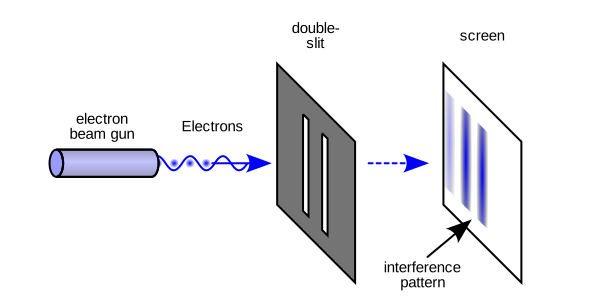
- Light unobserved → an interference pattern of bright and dark stripes on the screen — as if every photon went through both slits at the same time and interfered with itself.
- Light observed at the slits (a which-path detector at one slit) → the interference vanishes; we just see two single bright bands behind the two slits — as if every photon picked one slit and went through it like a bullet.
- Same photon, same apparatus — only the act of looking changes which result you get. Classical wave theory cannot explain the bullet-like behavior; classical particle theory cannot explain the interference. Both are stuck.
Supreme Polarity Theory explanation, in three steps:
- A photon is one Tai Chi node spinning along the time-string. Its bright/dark hemispheres flip rapidly. Its membrane is not a point — it has spatial extent across many neighbouring positions on the time-string skin.
- Unobserved → wide time-window. With nothing measuring it, the photon's membrane is read across the full duration of its flight. Both slits intersect the membrane patch at the same time, so the flip-pattern threads through both and interferes with itself on the back screen. The bright/dark stripes are the direct visual print of constructive vs. destructive flip-phase addition.
- Observed → time-window collapses to one instant. The which-path detector forces a measurement at one moment — and at any single moment a flipping node is just one bright dot in one place. The membrane patch is pinned to a single slit; nothing remains to thread through the other one; interference disappears and you see two single-slit bands.
Variants the same picture also covers without modification: the delayed-choice experiment (no retrocausality — the membrane is always both, the measurement window is what changes), the quantum eraser (erasing which-path information re-opens the interval, restoring interference), and interference of single photons sent one at a time (the flip-pattern of one node is itself spatially extended, so a single photon interferes with itself).
The Quantum Zeno Effect
The Quantum Zeno Effect — first predicted in 1977 and confirmed experimentally with trapped ions in 1990 — is the discovery that a quantum system that is observed continuously cannot evolve. A radioactive atom that is watched non-stop refuses to decay. A spinning electron that is measured every microsecond stops precessing. The faster you look, the more frozen the system becomes. Watching arrests evolution.
Standard quantum mechanics describes this with the projection postulate — each measurement "collapses" the wavefunction back to the observed state, leaving no time for the Schrödinger equation to act. But it cannot say what physically happens when an observation collapses a state. The collapse is a postulate, not a mechanism.
Supreme Polarity Theory gives the missing mechanism directly. Evolution of any quantum system is the flipping of its membrane between Yang and Yin. Each measurement narrows the time-window over which the membrane is read; with the window narrow enough, the node is caught at one instant and re-pinned to that orientation before it has had room to swing to the opposite face. The next measurement re-pins it again. And again. With repeated measurements arriving faster than the natural flip-period, the node spends almost all its time pinned and almost none flipping — so it never accumulates the change of state we call "evolution". That is why the watched atom does not decay.
The companion anti-Zeno effect (rapid measurements that speed up decay rather than freezing it, observed in 2001) follows from the same picture: when the measurement window happens to align with a fast sub-band of the membrane's flip spectrum instead of a slow one, the same pinning amplifies decay rather than suppressing it. Standard QM has to fit two separate calculations to the two effects; Supreme Polarity Theory has one mechanism for both.
Difficulties of older theories — and what Supreme Polarity Theory resolves
Every previous attempt at the wave-particle question left at least one fundamental difficulty unresolved. Supreme Polarity Theory's geometric picture closes them in a single move:
| Theory | Difficulty / open question | Supreme Polarity Theory answer |
|---|---|---|
| Newton's corpuscles (1704) | Could not explain interference, diffraction or the colors of thin films — light as a stream of bullets has no way to overlap with itself. | The flipping node is both extended (its membrane patch threads multiple paths) and pointlike at any instant — interference is direct, no extra mechanism needed. |
| Huygens' wave theory (1690) | Required a luminiferous aether (never found) and could not account for the photoelectric effect — energy is delivered in discrete packets, which a continuous wave cannot do. | There is no aether — there is only the time-string membrane; energy comes in packets because each Tai Chi node is one indivisible flip-quantum. |
| de Broglie matter waves (1924) | Said every particle has an associated wavelength but never explained what is waving — only that something must be. | What is waving is the flip of the node's membrane; wavelength is the spatial extent of one flip-cycle along the time-string skin. |
| Bohr complementarity (1928) | Asserted wave and particle are mutually exclusive descriptions, but never said why nature would impose such a rule — only that we must accept it. | They are not exclusive — they are two readings (interval vs. instant) of the same single object. The exclusion is an artefact of the measurement window, not a law of nature. |
| Copenhagen collapse (1927) | Used wavefunction collapse as a postulate without specifying what physically happens during a measurement. The "measurement problem" has stayed open for ~100 years. | There is no collapse — measurement just narrows the time-window. The same flipping node continues; only the slice we read changes. |
| Many-Worlds (1957) | Avoided collapse by branching the universe at every measurement — paying with infinite ontological cost and an empty-by-design experimental footprint. | No branching needed. The eight Bagua slices are finite and always there from the beginning; "alternative outcomes" are simply other slices of the same time-string already in existence. |
| Pilot wave / Bohmian (1952) | Restored a definite particle trajectory but required a non-local quantum potential whose origin remained unexplained. | The "non-local guidance" is just the spatial extent of the membrane patch — no extra field, no mystery. |
Comments — Wave–Particle Duality